
Restorative
Crowns and bridges
Protection for a damaged tooth, or a fixed way to fill a gap
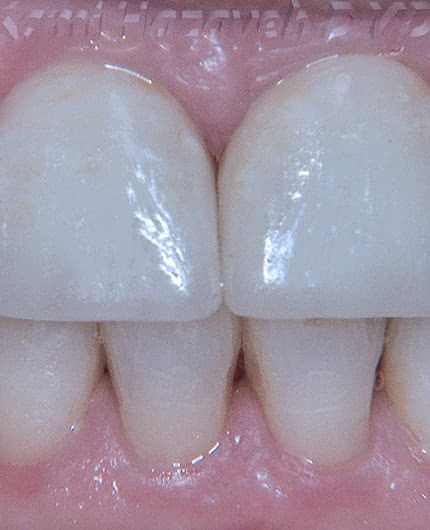
A crown is a cap made to fit over a damaged tooth, holding it together and restoring its shape, strength and colour. A bridge replaces one or more missing teeth by joining false teeth to crowns on the teeth either side, or to implants. Dr. Hazaveh designs and makes both in-house.
Visits
Usually two
01
A crown
Covers the whole tooth
02
A bridge
Fills a gap, fixed in place
03
A crown lets you keep your own tooth; a bridge keeps the rest of your teeth where they belong.
What they are
A dental crown is a tooth-shaped cap that covers the whole visible part of a tooth, down to the gum line. It’s used when a tooth is too damaged for a filling to hold, for example after a large cavity, a crack or a break, and to cap a dental implant. By holding the tooth together, a crown can stop a crack from spreading and help you keep the tooth.
A bridge replaces a missing tooth, or a few in a row, with a false tooth held between two crowns. The crowns fit over the natural teeth on either side of the gap, which act as anchors, or onto implants. The whole piece is cemented or screwed in place, so it feels secure when you eat and speak and is cleaned while it stays in your mouth. Filling the gap also stops the neighbouring teeth from tilting into it.
Crowns and bridges are made from porcelain or ceramic, matched to the shade of your other teeth. Dr. Hazaveh scans the prepared teeth, designs the restoration in CAD around your bite and makes it in the practice’s own lab, so the fit can be checked and refined without waiting on an outside lab. With good care, both often last many years.
Signs you might need one
- A tooth is cracked, chipped or broken
- A filling has grown so large that little natural tooth is left
- A tooth hurts when you bite, which can point to a crack
- A tooth is badly worn down from grinding
- You’re missing one tooth, or a few teeth in a row
- Your teeth have started to shift into a gap
What to expect
01
Examination
Dr. Hazaveh checks the tooth or the gap and takes X-rays to make sure the roots and surrounding bone are healthy. If there’s deep decay or infection, it’s treated first so the crown or bridge sits on a sound foundation.
02
Preparing the teeth
The tooth, or the anchor teeth beside a gap, are numbed and gently reshaped so the crowns can fit over them. Any decay is removed, and if a lot of tooth is missing, it may be built up first.
03
A scan and a temporary
The prepared teeth are scanned so your crown or bridge can be designed to fit precisely. You leave with a temporary that protects the teeth and fills any gap while the final piece is made in-house.
04
Fitting
At the next visit, the temporary is removed and your crown or bridge is checked for fit, bite and colour. Once you and Dr. Hazaveh are both happy with it, it’s fixed firmly in place.
Aftercare
Some sensitivity to hot and cold is common for a few days after a crown or bridge is fitted, and the gum around it may feel tender. A temporary is less sturdy than the final piece, so take a little care with it. Once the permanent work is in, you look after it like your other teeth, with daily cleaning under any bridge.
- With a temporary, avoid sticky or very hard foods on that side
- Brush and floss around the crown daily, especially at the gum line
- Clean under a bridge daily with a floss threader or water flosser
- Call us if your bite feels high or anything feels loose
- Ask about a night guard if you grind your teeth
Questions
Anything we haven’t covered? Call us on (610) 779-0911 and ask.
The tooth is numbed before it’s prepared, so most patients feel only pressure and vibration. Mild sensitivity or gum tenderness for a few days afterward is common and usually eases on its own. If discomfort lasts or gets worse, let us know.
With good care, both often last many years. How long yours last depends on the material, your bite, any grinding habit and how well you look after the teeth and gums around them. Regular check-ups help spot wear early.
Yes. Crowns and bridges are shaped and shaded to match your neighbouring teeth, and because they are designed on a scan and made in-house, the shape can be refined at the chair. In most cases people can’t tell which tooth has been restored.
Both are good options. An implant stands on its own and doesn’t involve the neighbouring teeth, while a traditional bridge is often quicker and avoids surgery. Your bone, your health and the condition of the nearby teeth all play a part, and Dr. Hazaveh will help you weigh them.
Yes. The crown itself can’t decay, but the natural tooth underneath can, especially where the crown meets the gum. Daily brushing and flossing, and regular check-ups, help prevent it. The same goes for the anchor teeth of a bridge.
Ready when you are. Call us and we’ll find a time that suits you
Mon–Fri 8am–7pm · Sat 8am–2pm · Sun closed
Call (610) 779-0911Related care
All services
Dental implants
A small post set in the jawbone that holds a natural-looking crown, bridge or denture in place of missing teeth, planned on a 3D scan.
Learn more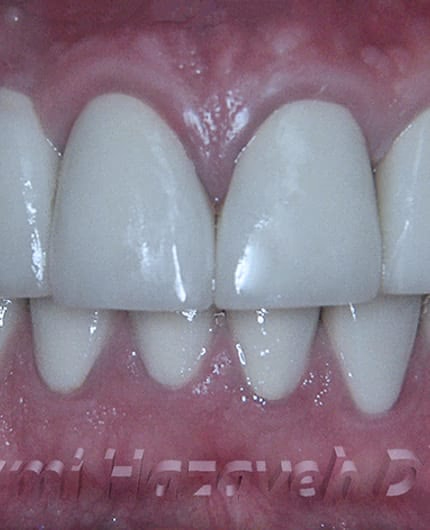
Full-mouth reconstruction
Rebuilding a mouth with many worn, broken or missing teeth, one plan at a time: crowns, bridges, implants and veneers designed together around your bite.
Learn more
Porcelain veneers
Thin porcelain shells bonded to the front of teeth to improve their shape, colour and line, designed and made in-house by Dr. Kami Hazaveh.
Learn more- 08 Every treatment, from whitening to All-on-4 All services